3.1 Agent and Multi-Agent System
3.1.1 What is an AI Agent?
While ChatGPT redefined human-computer interaction with “dialogue,” AI Agents are reshaping digital civilization with “action.” The essence of this transformation is to evolve machines from “answering questions” to “solving problems.” A major challenge for artificial intelligence is how to prioritize between application scenarios that emphasize productivity and more engaging chatbot-like applications. We focus on the former and believe that AI Agents are the development direction for the next generation of AI productivity.
Bill Gates once wrote on his official blog that everyone will have an AI personal assistant, an AI Agent, within five years. Meta founder Zuckerberg also stated that the next key stage in AI model development will be to handle more complex tasks and evolve into something more akin to an AI Agent, rather than just a simple chatbot. Gartner defines 2025 as the “Year of Agentic AI,” predicting that 15% of daily decisions will be autonomously made by AI Agents. Unlike centralized systems, the true AI Agent revolution will emerge from distributed networks. Imagine an ecosystem composed of millions of atomic AI Agents, each AI Agent like a neuron, exchanging value through blockchain smart contracts and federated learning, capable of completing complex tasks such as cross-border payments and supply chain optimization without a central server.
Agents can autonomously understand, plan decisions, and execute complex tasks. In the context of Large Language Models (LLMs), an AI Agent is an intelligent product built upon large language models that can autonomously perceive, plan decisions, and execute complex tasks. It can independently think and call tools to gradually achieve a given goal, without requiring humans to specify every step of the operation.
3.1.2 Distinction between Agent and Model
A model is a mathematical and architectural representation of a specific knowledge task, such as generating text output from text input, or classifying an image as a hot dog or not a hot dog. You provide a prompt, and the model computes a response based on the input. Each time you want a new output, you must provide a prompt; someone always needs to initiate the process.
AI Agents autonomously interact with the environment to complete knowledge tasks. AI Agents work differently; they are designed to think and act independently. You only need to provide a goal—such as researching a listed company or buying an ETF—and the AI Agent will generate a list of tasks and begin working. Relying on environmental feedback and internal thinking, AI Agents can prompt themselves and continuously evolve and adapt to achieve the goal in the best possible way.
In general, AI Agents use models to understand and interact with the environment and can execute tasks based on goals; they are often more complex than models.
3.1.3 Multi-Agent System and Single-Agent
AI Agents include reflex agents, model-based agents, goal-based agents, utility-based agents, learning agents, hierarchical agents, etc. Different types of agents are more efficient and effective at handling tasks within a single domain. However, in real-world environments, many complex problems cannot be solved by a single agent interacting with the environment alone. Directly applying single-agent algorithms to multi-agent systems is difficult to converge to an optimal solution because, from each agent’s perspective, the environment is no longer static.
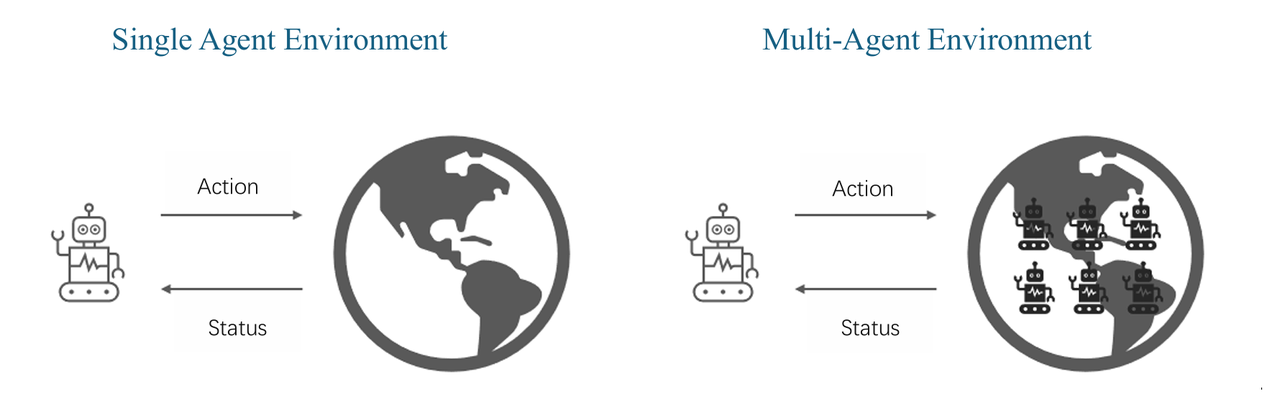
Compared to single-agent, multi-agent system has the following advantages:
- Multiple entities: There are multiple interacting Agents, capable of adapting to more complex scenarios;
- Distributed decision-making: Decisions are distributed among multiple Agents, which achieve overall goals through cooperation, competition, or negotiation. SIA leverages decentralization to enable autonomous optimization among multiple Agents, providing better efficiency and cost;
- Stronger environmental adaptability: Since multiple Agents can perceive and process the environment from different perspectives, the system as a whole has stronger adaptability to environmental changes;
- Task decomposition: Complex tasks are decomposed and jointly completed by different Agents, which not only distributes the load but also greatly improves Agent response speed;
- Complex interaction: Cooperation among Agents involves multi-dimensional dynamic relationships, and the system as a whole may exhibit capabilities beyond the sum of individual capabilities. Executing complex tasks through a multi-agent framework (Multi-Agent System, MAS) can effectively enhance the working ability of a single Agent. In the real world, many complex problems can be modeled as multiple sub-problems that can be coordinated, controlled, and optimized, and solved collaboratively by multiple Agents. MAS solves complex problems by organizing multiple Agents to cooperatively optimize the same objective function, such as automated control (multi-vehicle transportation delivery optimization), social simulation (multi-character collaboration in games), etc.
In SIA, each Agent can serve as an interface for a task. When an Agent receives a task, it needs to undertake basic functions including input, validation, and output. At the same time, Super Agents can grasp the overall situation of various Agents globally and drive them to collaborate.
The Multi-Agent Systems (MAS) framework of SIA has the following characteristics:
- Autonomy: Each Agent can autonomously control its behavior and state;
- Local Views: Each Agent can only obtain partial environmental information;
- Decentralization: No single Agent can control the entire system;
- Cooperation and Competition: Agents can cooperate with each other to achieve common goals, or compete with other Agents for their own interests.